
An Autonomous System Number, usually referred to as an ASN, is a globally unique numerical identifier used in Border Gateway Protocol, or BGP. BGP is the routing protocol that allows independent networks to exchange routing information across the public internet. When an organization operates its own ASN, it can establish a distinct routing identity and make independent decisions about how its IP traffic enters, leaves, and moves through its network.
For many businesses, applying for a RIPE NCC ASN is an important step toward building a more resilient and professionally managed network. An ASN is commonly used by internet service providers, data centers, hosting companies, cloud infrastructure providers, financial institutions, content delivery platforms, gaming companies, large enterprises, and organizations with multi-site or multi-provider connectivity requirements.
The RIPE NCC ASN application process is not simply an administrative registration. It involves demonstrating a valid technical need, providing accurate organizational information, and preparing for the operational responsibilities that come with running BGP. While an ASN may be assigned relatively quickly in a well-prepared case, the full journey from application to production BGP routing requires planning, coordination, and careful configuration.
This guide explains the complete RIPE NCC ASN application process, the typical timeline, the role of a sponsoring LIR or ASN application agency, and the technical steps that should follow after an ASN is assigned.
What Is an ASN and What Does It Do?
An Autonomous System is a network or group of networks managed under a common routing policy. The ASN is the unique number that identifies that autonomous system on the global internet. When a network announces IP prefixes through BGP, its ASN appears in the routing path used by other networks to determine how traffic should be delivered.
For example, a company operating its own data centers may connect to two transit providers for redundancy. Instead of relying entirely on one provider’s routing policy, the company can use its ASN to announce its own IP address prefixes to both providers. This allows the company to influence inbound and outbound traffic, improve redundancy, select preferred routes, and reduce dependence on a single upstream network.
An ASN is particularly valuable when an organization needs to be multihomed. Multihoming generally means connecting a network to more than one external network, often through multiple transit providers, Internet Exchange Points, private peers, cloud on-ramps, or geographically separate facilities. If one connection fails, traffic can continue through another available path, provided that the network is designed and configured correctly.
However, an ASN is not necessary for every organization. A small business with one internet connection, a simple office network, or a hosted application that relies entirely on a cloud provider may not need to operate BGP or maintain its own autonomous system. The decision to apply for an ASN should be based on genuine routing, resilience, scale, and operational needs.
RIPE NCC and the Role of the Regional Internet Registry
RIPE NCC is one of the world’s five Regional Internet Registries. It serves Europe, the Middle East, and parts of Central Asia. Its role includes coordinating the registration of internet number resources such as IPv4 addresses, IPv6 addresses, and Autonomous System Numbers within its service region.
The RIPE NCC maintains registration data in the RIPE Database. This public database contains information about internet number resources, network operators, contacts, routing policies, and related technical objects. Accurate registry data is important because it helps network operators, security teams, upstream providers, and other parties verify who is responsible for a resource and how it is intended to be used.
In most practical cases, a business does not apply to RIPE NCC as an individual end user without an intermediary. Instead, the company works with a Local Internet Registry, known as an LIR. An LIR is typically a RIPE NCC member that can request and manage internet number resources for itself or for end users.
A sponsoring LIR provides a route for organizations that need an ASN but do not want to become a direct RIPE NCC member. This model is commonly used by startups, hosting providers, international companies, small and medium-sized enterprises, and organizations that need a limited number of resources without the cost or administrative burden of full membership.
RIPE NCC ASN Application Through a Sponsoring LIR
A sponsoring LIR acts as the registry-facing service provider for the ASN application. The sponsoring LIR reviews the applicant’s documentation, submits the request through the appropriate RIPE NCC process, and helps maintain the registration relationship after the ASN is assigned.
This does not mean that the ASN should be treated as an ordinary commercial product. Internet number resources are registered and administered under policy and contractual frameworks. The applicant should understand whether it will be recorded as the end user or resource holder, what annual service fees apply, what happens if the sponsoring LIR relationship ends, and whether a future transfer or sponsor change can be supported.
A reputable ASN application agency or sponsoring LIR should be transparent about these issues before the application begins. The provider should explain the initial application fee, recurring annual maintenance fees, documentation requirements, response times, support scope, and responsibilities of both parties. It should also clarify whether the quoted service includes future updates to organization details, registry objects, RPKI assistance, route object creation, or technical consultation for BGP deployment.
Choosing the right sponsoring LIR can make the process much smoother. The best provider is not necessarily the one with the lowest advertised initial price. A professional provider should have clear procedures, reliable support, accurate registry practices, and an understanding of BGP operations, RPKI, route filtering, and resource lifecycle management.
Who Is Eligible to Apply for a RIPE NCC ASN?
An ASN request should be supported by a real operational need. In general, the applicant must be able to show that it operates, or intends to operate, a network with an independent routing policy. This usually means that the network will make its own BGP routing decisions rather than simply using the routing policy of one upstream provider.
A common use case is a multihomed network connected to two or more external networks. For instance, a data center operator may connect to two upstream carriers; a cloud company may use multiple connectivity partners across separate regions; or an enterprise may connect to both transit providers and an Internet Exchange Point. In these cases, an ASN can enable route redundancy and traffic engineering.
Another possible justification is a unique routing policy that cannot be handled appropriately under an upstream provider’s ASN. The applicant should be able to explain why independent BGP routing is necessary for its network architecture, business continuity requirements, connectivity design, or service delivery model.
The application should not rely on vague claims such as “we may need an ASN in the future” or “we want more control over the network.” A stronger explanation describes the actual infrastructure, expected providers or peers, intended IP prefixes, planned BGP sessions, and routing objectives. The clearer the technical rationale, the less likely the request will be delayed by follow-up questions.
Applicants should also ensure that the legal entity applying for the ASN is correctly identified. If a parent company, subsidiary, operating company, or managed-service provider is involved, the relationship should be explained clearly. Inconsistencies between company documents, contact information, network operation details, and registry records can create avoidable delays.
Documents Required for a RIPE NCC ASN Application
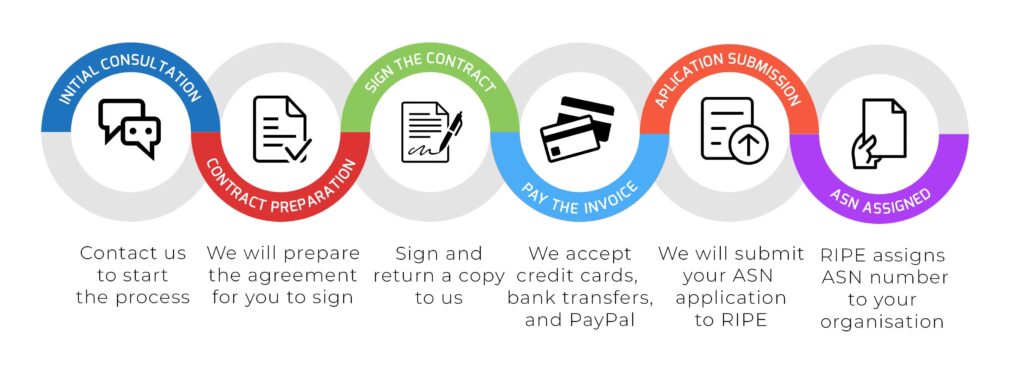
The exact documentation requirements can vary depending on the sponsoring LIR and the applicant’s jurisdiction. In most cases, a company will need to provide formal identification documents for the legal entity requesting the ASN. These may include a certificate of incorporation, business registration certificate, company registration number, legal company name, and registered business address.
The sponsoring LIR may also request the name and contact details of an authorized representative. This person should be able to confirm that the company has authorized the ASN request and that the information provided is accurate. In some cases, additional authorization documents may be required when the person submitting the application is not listed as a director, legal representative, or recognized company officer.
Technical information is a central part of the application. The applicant should be ready to describe its network topology, intended upstream connectivity, BGP implementation plan, peering arrangements, data center locations, and route control requirements. The goal is not to produce an unnecessarily complex engineering document. Instead, the application should clearly show that the ASN will be used by a real network with an independent routing purpose.
It is helpful to prepare the technical explanation in advance. A short but precise statement can often be sufficient when it includes the key facts. For example, a company may explain that it will operate infrastructure in two data centers, connect to two independent transit providers, announce its own IPv6 or IPv4 prefixes through BGP, and use routing policy controls to maintain service availability during carrier outages.
Step One: Assess Whether an ASN Is Actually Needed
Before beginning the RIPE NCC ASN application process, an organization should confirm that an ASN is the correct solution for its network requirements. This assessment is important because BGP introduces technical responsibility. Operating an autonomous system involves not only receiving an ASN but also managing routing policies, route authorization, contact information, network security, and coordination with upstream providers.
A company that simply needs internet access at multiple offices may be better served by provider-managed connectivity, SD-WAN, cloud networking, or a managed MPLS service. These options can provide redundancy without requiring the company to operate public BGP directly.
On the other hand, an ASN is often appropriate where the organization needs portability of routing policy, independent control of prefix announcements, multi-provider resilience, direct Internet Exchange Point peering, or the ability to build an internet-facing network under its own operational identity.
At this stage, the business should also confirm whether it has suitable technical personnel or a managed network provider. BGP misconfigurations can cause serious service interruptions, route leaks, accidental prefix announcements, or loss of global reachability. An ASN should therefore be part of a well-considered network design rather than an isolated administrative purchase.
Step Two: Choose a RIPE NCC Sponsoring LIR or ASN Application Agency
Once the ASN requirement is confirmed, the next step is choosing the organization that will handle the application. Some businesses decide to become direct RIPE NCC members, especially if they expect to manage a larger portfolio of internet resources or want direct access to membership services. For many companies, however, a sponsoring LIR is more practical.
A sponsoring LIR can manage the submission process and support the end user throughout the resource lifecycle. When comparing providers, companies should evaluate more than the initial application cost. They should ask how long document review usually takes, what support is included after assignment, whether annual fees are fixed or variable, and whether the provider can assist with future registry maintenance.
It is also important to understand the provider’s policy for changing sponsors. A company may later wish to move its ASN to another sponsoring LIR because of pricing, support quality, corporate restructuring, or a broader change in network management. A professional provider should explain how this process works and what verification may be required.
The applicant should never assume that all providers offer identical terms. A clear written service agreement and transparent explanation of registry roles can reduce future disputes and ensure that the ASN remains properly associated with the intended operating organization.
Step Three: Submit Company Information and Technical Justification
After selecting a sponsoring LIR, the applicant submits its legal documents and technical information. The sponsoring LIR normally performs an initial review before moving forward with the registry request.
This review is valuable because it identifies missing information early. A company document may be expired, a legal address may not match the registration certificate, or the technical explanation may not clearly demonstrate an independent routing policy. Resolving these matters before submission is usually faster than responding to repeated clarification requests later.
The technical justification should remain factual and operational. It should describe the planned BGP environment, not merely business aspirations. Relevant details can include the number of intended upstream providers, peering plans, location of network infrastructure, expected IP prefix announcements, and the availability or traffic-engineering goals of the deployment.
If the organization is using a third-party network operator, managed service provider, or data center to operate BGP, this should be reflected accurately. The registry record should clearly distinguish the legal end user, the operational network contact, and any technical service provider involved in the deployment.
Step Four: Registry Submission and Review
Once the application package is complete, the sponsoring LIR submits the ASN request through the applicable RIPE NCC process. During this phase, the organization’s data is prepared for registration in the RIPE Database and the request is reviewed according to current policies and procedures.
The timeline at this stage depends heavily on the quality of the initial submission. Straightforward applications with complete documents and a clear routing need may progress quickly. Applications that include inconsistent business records, unclear ownership structures, incomplete contact information, or weak technical justification can take longer.
The sponsoring LIR may contact the applicant for clarification. This is a normal part of the process and should not be treated as a rejection. In many cases, a short explanation or an updated document is enough to resolve the issue. Fast responses from the applicant can significantly reduce the overall processing time.
Applicants should remember that registry policies and implementation procedures may change. Exact requirements, forms, and review expectations should always be confirmed with the sponsoring LIR at the time of application. A professional provider should use current policy guidance rather than relying on outdated assumptions about ASN eligibility or documentation.
Step Five: ASN Assignment and RIPE Database Registration
After the request is approved, the ASN is assigned and registered. The applicant will receive the ASN number and confirmation of the associated registration details. At this point, the administrative part of the ASN application has been completed, but the ASN is not automatically active on the global internet.
The assigned ASN must be integrated into the organization’s routing environment. The network operator will need to configure BGP sessions with transit providers, peers, or Internet Exchange Points. It may also need to publish relevant routing information and meet the filtering requirements imposed by upstream networks.
Registration accuracy remains important after assignment. The organization should verify that its legal name, address, administrative contacts, technical contacts, abuse contact details, and sponsoring-LIR relationship are correct. Outdated or inaccurate records can complicate future network changes, security investigations, resource transfers, or provider onboarding.
A well-managed ASN is part of a broader internet resource management program. It should be treated as long-term infrastructure, not as a one-time registration task.
RIPE NCC ASN Application Timeline: How Long Does It Take?
The typical RIPE NCC ASN application timeline is often between one and three weeks when documentation is complete, the technical need is clearly explained, and the applicant responds promptly to any questions. However, this estimate should be treated as a planning guideline rather than a guarantee.
Some straightforward applications may move from document submission to ASN assignment within several business days. This is more likely when the company documents are easy to verify, the applicant’s network plan is clear, and the sponsoring LIR has already received all required information.
More complex cases can take longer. Delays may occur when corporate records require translation or clarification, when the organization operates across multiple jurisdictions, when the end user and network operator are different entities, or when the technical justification does not clearly establish why the ASN is required.
The ASN assignment timeline should also be separated from the BGP deployment timeline. Even after the ASN is issued, the organization may need additional time to configure routers, establish connectivity with transit providers, create routing objects, set up RPKI authorizations, and conduct testing. Depending on the network environment, this operational phase can take from a few days to several weeks.
For a production project, businesses should plan for both phases. The administrative ASN application may be completed quickly, but a secure and stable BGP launch requires coordination between the company, the sponsoring LIR, hosting providers, transit carriers, network engineers, and security teams.
BGP Configuration After Receiving a RIPE NCC ASN
After ASN assignment, the organization must configure BGP on its network equipment or managed routing platform. This usually involves establishing BGP sessions with one or more upstream providers, defining route policies, setting prefix limits, configuring filtering, and monitoring the health of routing sessions.
Each upstream provider may have its own onboarding requirements. Providers often request the ASN, the list of IP prefixes to be announced, routing registry information, and evidence of route authorization. They may also apply prefix filters, maximum-prefix limits, RPKI validation policies, and strict requirements for route objects.
The company should prepare these details before requesting activation from its carriers. A delay in route-object creation or RPKI configuration can prevent prefixes from being accepted, even when the ASN itself has already been assigned.
For organizations without in-house BGP expertise, it is advisable to use a qualified network engineer or managed network service provider. The initial configuration should be tested carefully in a controlled manner. Route leaks, overly broad announcements, incorrect ASN paths, or missing filters can affect both the organization and external networks.
The Importance of IRR Route Objects and RPKI
An ASN alone does not authorize a network to announce any IP prefix it chooses. Routing security depends on additional records and validation mechanisms. Two important components are Internet Routing Registry, or IRR, route objects and Resource Public Key Infrastructure, known as RPKI.
A route object typically documents that a specific IP prefix is intended to originate from a specific ASN. Many transit providers use these objects to build routing filters. If a route object is missing or incorrect, an upstream provider may refuse to accept the announcement.
RPKI adds cryptographic authorization through Route Origin Authorizations, or ROAs. A ROA states which ASN is allowed to originate a specific IP prefix and can define the maximum prefix length that may be announced. Networks that perform RPKI route origin validation may reject or deprioritize invalid routes.
For this reason, ASN applicants should consider RPKI as part of the standard deployment process, not an optional afterthought. Proper RPKI configuration improves routing security, reduces the risk of unauthorized announcements, and helps protect the reputation and reachability of the network.
Ongoing ASN Management and Compliance
Receiving an ASN creates ongoing responsibilities. The resource holder or end user should keep legal, administrative, technical, and abuse contacts current. If the company changes its registered name, address, legal structure, or operational network team, relevant records may need to be updated through the sponsoring LIR.
The network should also be monitored for BGP incidents. Operators should watch for route leaks, incorrect announcements, unexpected origin changes, RPKI invalid states, and prefix-filtering problems. Many routing incidents are preventable through strong policies, automated validation, configuration reviews, and active monitoring.
If the company no longer needs the ASN, it should discuss the appropriate return or closure process with its sponsoring LIR. Similarly, if the company wants to change service providers, reorganize its corporate structure, or transfer management of the network, it should obtain guidance before making changes. Registry and contractual requirements may apply, and early planning usually makes the process easier.
Common Mistakes During the RIPE NCC ASN Application Process
One common mistake is applying for an ASN without a complete network plan. An ASN request should be supported by a real routing requirement, not only by a desire to own a network identifier. Businesses should identify their upstream providers, routing objectives, and technical operating model before submitting the request.
Another issue is inconsistent company information. The legal name in the application should match the registration documents. Authorized contacts should be clearly identified, and the relationship between parent companies, subsidiaries, technical operators, and end users should be explained where necessary.
Some applicants also underestimate the work required after assignment. They obtain an ASN but have not arranged BGP transit, IP address resources, router configuration, RPKI setup, or route-object registration. This can delay production activation and create unnecessary pressure during deployment.
Finally, companies should avoid choosing a sponsoring LIR solely on the basis of the lowest application price. Long-term support, transparent annual fees, accurate resource records, sponsor-change procedures, and routing expertise often provide greater value than a small difference in initial cost.
Frequently Asked Questions About RIPE NCC ASN Applications
Do I need to be a RIPE NCC member to apply for an ASN?
No. Many organizations obtain an ASN through a sponsoring LIR. This allows the organization to receive an ASN without becoming a direct RIPE NCC member, subject to the applicable policies and service terms.
Can a RIPE NCC ASN be used outside Europe?
Yes. An ASN issued through the RIPE NCC system can be used in global BGP routing. Its visibility and usability depend on proper network configuration, accepted route authorizations, and the policies of upstream providers and peers.
Do I need IPv4 addresses before applying for an ASN?
Not necessarily. An ASN can support IPv6-only networks, IPv4 networks, or dual-stack environments. The key consideration is whether the organization has a genuine independent routing requirement and a practical BGP deployment plan.
How quickly can I start announcing routes after ASN assignment?
This depends on how well prepared the network is. If router configuration, transit contracts, route objects, and RPKI authorizations are already ready, activation may be relatively fast. If these elements still need to be prepared, production routing will take longer than the ASN assignment itself.
Can I change my sponsoring LIR later?
In many cases, it may be possible to change the sponsoring LIR, subject to applicable procedures, verification, and contractual conditions. Applicants should confirm the process and potential fees with their current and future sponsoring providers.
Plan the ASN Application as Part of Your Network Strategy
A RIPE NCC ASN is a valuable resource for businesses that need independent BGP routing, multi-provider redundancy, improved traffic control, Internet Exchange Point peering, or a scalable internet infrastructure strategy. The application process is usually manageable when the company has complete legal documents, a clear technical justification, and an experienced sponsoring LIR.
For most well-prepared applicants, the administrative RIPE NCC ASN application process can often be completed within one to three weeks. However, the complete timeline should include BGP deployment, provider coordination, route-object registration, RPKI configuration, and production testing.
The most successful ASN projects begin with a clear operational purpose. Businesses should define why they need independent routing, identify their connectivity partners, prepare accurate documentation, and select a sponsoring LIR that can provide transparent long-term support. With the right preparation, a RIPE NCC ASN can become the foundation for a more reliable, flexible, and professionally managed network.