
一个 自治系统编号,通常称为ASN,是一个全局唯一的数字标识符,用于边界网关协议(BGP)。BGP是允许独立网络在公共互联网上交换路由信息的路由协议。当组织使用自己的ASN时,它可以建立独特的路由身份,并独立决定其IP流量如何进入、离开和在其网络中移动。
对于许多企业来说,申请RIPE NCC的ASN是构建更具弹性和专业管理的网络的重要一步。ASN通常由互联网服务提供商、数据中心、托管公司、云基础设施提供商、金融机构、内容分发平台、游戏公司、大型企业和具有多站点或多供应商连接需求的组织使用。
RIPE NCC的ASN申请流程不仅仅是一项行政注册。它涉及展示有效的技术需求,提供准确的组织信息,并为运行BGP所带来的运营责任做好准备。虽然在准备充分的情况下,ASN可能很快被分配,但从申请到生产BGP路由的整个过程需要计划、协调和仔细配置。
本指南解释了完整的RIPE NCC ASN申请流程、典型时间线、担保LIR或ASN申请机构的作用,以及分配ASN后应进行的技术步骤。
什么是ASN以及它的作用?
自治系统是一个网络或一组网络,它们在共同的路由策略下进行管理。ASN是唯一标识该自治系统在全球互联网上的编号。当一个网络通过BGP宣告IP前缀时,其ASN会出现在其他网络用来确定如何传递流量的路由路径中。
例如,一家运营自有数据中心的公司可能会连接到两个传输提供商以实现冗余。该公司可以使用自己的ASN向两个提供商宣布自己的IP地址前缀,而不是完全依赖于一个提供商的路由策略。这使公司能够影响进出流量,提高冗余性,选择首选路径,并减少对单一上游网络的依赖。
一个ASN在组织需要多归属时尤其有价值。多归属通常意味着将网络连接到多个外部网络,通常是通过多个传输提供商、互联网交换点、私人对等方、云接入点或地理位置不同的设施。如果一个连接出现故障,只要网络设计和配置正确,流量可以通过另一个可用路径继续传输。
然而,并非每个组织都需要ASN。拥有单一互联网连接的小型企业、简单的办公室网络,或完全依赖云服务提供商的托管应用程序可能不需要运行BGP或维护自己的自治系统。申请ASN的决定应基于真实的路由、弹性、规模和运营需求。
RIPE NCC和区域互联网注册机构的作用
RIPE NCC是全球五个区域互联网注册机构之一。它服务于欧洲、中东和中亚部分地区。其职责包括协调互联网号码资源的注册,如IPv4地址、IPv6地址和自治系统编号在其服务区域内。
RIPE NCC在RIPE数据库中维护注册数据。这个公共数据库包含有关互联网号码资源、网络运营商、联系人、路由策略和相关技术对象的信息。准确的注册数据很重要,因为它有助于网络运营商、安全团队、上游提供商和其他相关方验证谁对某个资源负责以及该资源 intended 如何使用。
在大多数实际情况下,企业不会作为个人最终用户直接向RIPE NCC申请,而是通过中间机构进行。相反,公司会与本地互联网注册机构(称为LIR)合作。LIR通常是一个RIPE NCC成员,可以为自己或最终用户请求和管理互联网编号资源。
一个赞助的LIR为需要ASN但不想成为直接RIPE NCC成员的组织提供路由。这种模式通常被初创企业、托管服务商、国际公司、中小型企业以及不需要大量资源且不愿承担完整会员成本或管理负担的组织所使用。
RIPE NCC ASN 通过一个 Sponsoring LIR
一个赞助的LIR作为ASN申请的注册机构面向服务提供商。赞助的LIR审查申请人的文件,通过适当的RIPE NCC流程提交请求,并在分配ASN后帮助维护注册关系。
这并不意味着应将ASN视为普通商业产品。互联网号码资源是在政策和合同框架下进行注册和管理的。申请人应了解其是否会被记录为最终用户或资源持有者,适用哪些年度服务费用,如果资助LIR关系终止会发生什么,以及是否可以支持未来的转移或赞助商变更。
一个可信的ASN申请代理机构或资助LIR应在申请开始前就这些问题保持透明。提供者应解释初始申请费用、定期的年度维护费用、文件要求、响应时间、支持范围以及双方的责任。还应明确报价的服务是否包括组织详情、注册对象、RPKI协助、路由对象创建或BGP部署的技术咨询的未来更新。
选择合适的赞助LIR可以使整个过程更加顺畅。最好的供应商不一定是广告中初始价格最低的那个。专业供应商应具备清晰的流程、可靠的支持、准确的注册机构实践,以及对BGP操作、RPKI、路由过滤和资源生命周期管理的理解。
Who Is Eligible to Apply for a RIPE NCC ASN?
An ASN request should be supported by a real operational need. In general, the applicant must be able to show that it operates, or intends to operate, a network with an independent routing policy. This usually means that the network will make its own BGP routing decisions rather than simply using the routing policy of one upstream provider.
A common use case is a multihomed network connected to two or more external networks. For instance, a data center operator may connect to two upstream carriers; a cloud company may use multiple connectivity partners across separate regions; or an enterprise may connect to both transit providers and an Internet Exchange Point. In these cases, an ASN can enable route redundancy and traffic engineering.
Another possible justification is a unique routing policy that cannot be handled appropriately under an upstream provider’s ASN. The applicant should be able to explain why independent BGP routing is necessary for its network architecture, business continuity requirements, connectivity design, or service delivery model.
The application should not rely on vague claims such as “we may need an ASN in the future” or “we want more control over the network.” A stronger explanation describes the actual infrastructure, expected providers or peers, intended IP prefixes, planned BGP sessions, and routing objectives. The clearer the technical rationale, the less likely the request will be delayed by follow-up questions.
Applicants should also ensure that the legal entity applying for the ASN is correctly identified. If a parent company, subsidiary, operating company, or managed-service provider is involved, the relationship should be explained clearly. Inconsistencies between company documents, contact information, network operation details, and registry records can create avoidable delays.
Documents Required for a RIPE NCC ASN Application
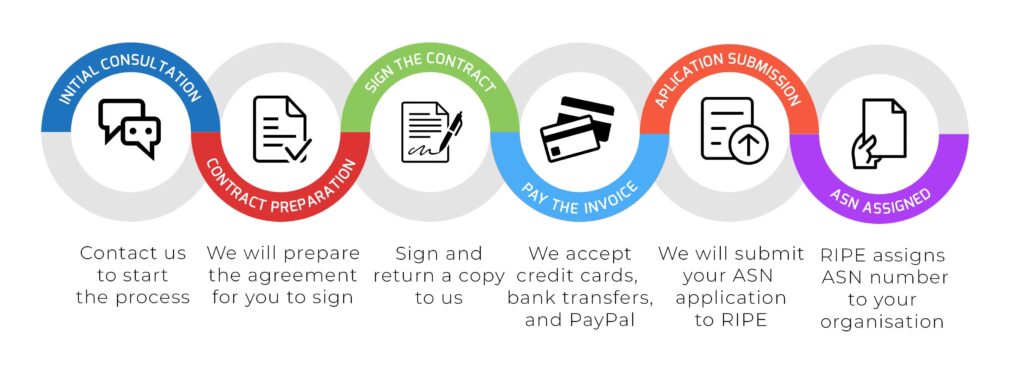
The exact documentation requirements can vary depending on the sponsoring LIR and the applicant’s jurisdiction. In most cases, a company will need to provide formal identification documents for the legal entity requesting the ASN. These may include a certificate of incorporation, business registration certificate, company registration number, legal company name, and registered business address.
The sponsoring LIR may also request the name and contact details of an authorized representative. This person should be able to confirm that the company has authorized the ASN request and that the information provided is accurate. In some cases, additional authorization documents may be required when the person submitting the application is not listed as a director, legal representative, or recognized company officer.
Technical information is a central part of the application. The applicant should be ready to describe its network topology, intended upstream connectivity, BGP implementation plan, peering arrangements, data center locations, and route control requirements. The goal is not to produce an unnecessarily complex engineering document. Instead, the application should clearly show that the ASN will be used by a real network with an independent routing purpose.
It is helpful to prepare the technical explanation in advance. A short but precise statement can often be sufficient when it includes the key facts. For example, a company may explain that it will operate infrastructure in two data centers, connect to two independent transit providers, announce its own IPv6 or IPv4 prefixes through BGP, and use routing policy controls to maintain service availability during carrier outages.
Step One: Assess Whether an ASN Is Actually Needed
Before beginning the RIPE NCC ASN application process, an organization should confirm that an ASN is the correct solution for its network requirements. This assessment is important because BGP introduces technical responsibility. Operating an autonomous system involves not only receiving an ASN but also managing routing policies, route authorization, contact information, network security, and coordination with upstream providers.
A company that simply needs internet access at multiple offices may be better served by provider-managed connectivity, SD-WAN, cloud networking, or a managed MPLS service. These options can provide redundancy without requiring the company to operate public BGP directly.
On the other hand, an ASN is often appropriate where the organization needs portability of routing policy, independent control of prefix announcements, multi-provider resilience, direct Internet Exchange Point peering, or the ability to build an internet-facing network under its own operational identity.
At this stage, the business should also confirm whether it has suitable technical personnel or a managed network provider. BGP misconfigurations can cause serious service interruptions, route leaks, accidental prefix announcements, or loss of global reachability. An ASN should therefore be part of a well-considered network design rather than an isolated administrative purchase.
Step Two: Choose a RIPE NCC Sponsoring LIR or ASN Application Agency
Once the ASN requirement is confirmed, the next step is choosing the organization that will handle the application. Some businesses decide to become direct RIPE NCC members, especially if they expect to manage a larger portfolio of internet resources or want direct access to membership services. For many companies, however, a sponsoring LIR is more practical.
A sponsoring LIR can manage the submission process and support the end user throughout the resource lifecycle. When comparing providers, companies should evaluate more than the initial application cost. They should ask how long document review usually takes, what support is included after assignment, whether annual fees are fixed or variable, and whether the provider can assist with future registry maintenance.
It is also important to understand the provider’s policy for changing sponsors. A company may later wish to move its ASN to another sponsoring LIR because of pricing, support quality, corporate restructuring, or a broader change in network management. A professional provider should explain how this process works and what verification may be required.
The applicant should never assume that all providers offer identical terms. A clear written service agreement and transparent explanation of registry roles can reduce future disputes and ensure that the ASN remains properly associated with the intended operating organization.
Step Three: Submit Company Information and Technical Justification
After selecting a sponsoring LIR, the applicant submits its legal documents and technical information. The sponsoring LIR normally performs an initial review before moving forward with the registry request.
This review is valuable because it identifies missing information early. A company document may be expired, a legal address may not match the registration certificate, or the technical explanation may not clearly demonstrate an independent routing policy. Resolving these matters before submission is usually faster than responding to repeated clarification requests later.
The technical justification should remain factual and operational. It should describe the planned BGP environment, not merely business aspirations. Relevant details can include the number of intended upstream providers, peering plans, location of network infrastructure, expected IP prefix announcements, and the availability or traffic-engineering goals of the deployment.
If the organization is using a third-party network operator, managed service provider, or data center to operate BGP, this should be reflected accurately. The registry record should clearly distinguish the legal end user, the operational network contact, and any technical service provider involved in the deployment.
Step Four: Registry Submission and Review
Once the application package is complete, the sponsoring LIR submits the ASN request through the applicable RIPE NCC process. During this phase, the organization’s data is prepared for registration in the RIPE Database and the request is reviewed according to current policies and procedures.
The timeline at this stage depends heavily on the quality of the initial submission. Straightforward applications with complete documents and a clear routing need may progress quickly. Applications that include inconsistent business records, unclear ownership structures, incomplete contact information, or weak technical justification can take longer.
The sponsoring LIR may contact the applicant for clarification. This is a normal part of the process and should not be treated as a rejection. In many cases, a short explanation or an updated document is enough to resolve the issue. Fast responses from the applicant can significantly reduce the overall processing time.
Applicants should remember that registry policies and implementation procedures may change. Exact requirements, forms, and review expectations should always be confirmed with the sponsoring LIR at the time of application. A professional provider should use current policy guidance rather than relying on outdated assumptions about ASN eligibility or documentation.
Step Five: ASN Assignment and RIPE Database Registration
After the request is approved, the ASN is assigned and registered. The applicant will receive the ASN number and confirmation of the associated registration details. At this point, the administrative part of the ASN application has been completed, but the ASN is not automatically active on the global internet.
The assigned ASN must be integrated into the organization’s routing environment. The network operator will need to configure BGP sessions with transit providers, peers, or Internet Exchange Points. It may also need to publish relevant routing information and meet the filtering requirements imposed by upstream networks.
Registration accuracy remains important after assignment. The organization should verify that its legal name, address, administrative contacts, technical contacts, abuse contact details, and sponsoring-LIR relationship are correct. Outdated or inaccurate records can complicate future network changes, security investigations, resource transfers, or provider onboarding.
A well-managed ASN is part of a broader internet resource management program. It should be treated as long-term infrastructure, not as a one-time registration task.
RIPE NCC ASN Application Timeline: How Long Does It Take?
The typical RIPE NCC ASN application timeline is often between one and three weeks when documentation is complete, the technical need is clearly explained, and the applicant responds promptly to any questions. However, this estimate should be treated as a planning guideline rather than a guarantee.
Some straightforward applications may move from document submission to ASN assignment within several business days. This is more likely when the company documents are easy to verify, the applicant’s network plan is clear, and the sponsoring LIR has already received all required information.
More complex cases can take longer. Delays may occur when corporate records require translation or clarification, when the organization operates across multiple jurisdictions, when the end user and network operator are different entities, or when the technical justification does not clearly establish why the ASN is required.
The ASN assignment timeline should also be separated from the BGP deployment timeline. Even after the ASN is issued, the organization may need additional time to configure routers, establish connectivity with transit providers, create routing objects, set up RPKI authorizations, and conduct testing. Depending on the network environment, this operational phase can take from a few days to several weeks.
For a production project, businesses should plan for both phases. The administrative ASN application may be completed quickly, but a secure and stable BGP launch requires coordination between the company, the sponsoring LIR, hosting providers, transit carriers, network engineers, and security teams.
BGP Configuration After Receiving a RIPE NCC ASN
After ASN assignment, the organization must configure BGP on its network equipment or managed routing platform. This usually involves establishing BGP sessions with one or more upstream providers, defining route policies, setting prefix limits, configuring filtering, and monitoring the health of routing sessions.
Each upstream provider may have its own onboarding requirements. Providers often request the ASN, the list of IP prefixes to be announced, routing registry information, and evidence of route authorization. They may also apply prefix filters, maximum-prefix limits, RPKI validation policies, and strict requirements for route objects.
The company should prepare these details before requesting activation from its carriers. A delay in route-object creation or RPKI configuration can prevent prefixes from being accepted, even when the ASN itself has already been assigned.
For organizations without in-house BGP expertise, it is advisable to use a qualified network engineer or managed network service provider. The initial configuration should be tested carefully in a controlled manner. Route leaks, overly broad announcements, incorrect ASN paths, or missing filters can affect both the organization and external networks.
The Importance of IRR Route Objects and RPKI
An ASN alone does not authorize a network to announce any IP prefix it chooses. Routing security depends on additional records and validation mechanisms. Two important components are Internet Routing Registry, or IRR, route objects and Resource Public Key Infrastructure, known as RPKI.
A route object typically documents that a specific IP prefix is intended to originate from a specific ASN. Many transit providers use these objects to build routing filters. If a route object is missing or incorrect, an upstream provider may refuse to accept the announcement.
RPKI adds cryptographic authorization through Route Origin Authorizations, or ROAs. A ROA states which ASN is allowed to originate a specific IP prefix and can define the maximum prefix length that may be announced. Networks that perform RPKI route origin validation may reject or deprioritize invalid routes.
For this reason, ASN applicants should consider RPKI as part of the standard deployment process, not an optional afterthought. Proper RPKI configuration improves routing security, reduces the risk of unauthorized announcements, and helps protect the reputation and reachability of the network.
Ongoing ASN Management and Compliance
Receiving an ASN creates ongoing responsibilities. The resource holder or end user should keep legal, administrative, technical, and abuse contacts current. If the company changes its registered name, address, legal structure, or operational network team, relevant records may need to be updated through the sponsoring LIR.
The network should also be monitored for BGP incidents. Operators should watch for route leaks, incorrect announcements, unexpected origin changes, RPKI invalid states, and prefix-filtering problems. Many routing incidents are preventable through strong policies, automated validation, configuration reviews, and active monitoring.
If the company no longer needs the ASN, it should discuss the appropriate return or closure process with its sponsoring LIR. Similarly, if the company wants to change service providers, reorganize its corporate structure, or transfer management of the network, it should obtain guidance before making changes. Registry and contractual requirements may apply, and early planning usually makes the process easier.
Common Mistakes During the RIPE NCC ASN Application Process
One common mistake is applying for an ASN without a complete network plan. An ASN request should be supported by a real routing requirement, not only by a desire to own a network identifier. Businesses should identify their upstream providers, routing objectives, and technical operating model before submitting the request.
Another issue is inconsistent company information. The legal name in the application should match the registration documents. Authorized contacts should be clearly identified, and the relationship between parent companies, subsidiaries, technical operators, and end users should be explained where necessary.
Some applicants also underestimate the work required after assignment. They obtain an ASN but have not arranged BGP transit, IP address resources, router configuration, RPKI setup, or route-object registration. This can delay production activation and create unnecessary pressure during deployment.
Finally, companies should avoid choosing a sponsoring LIR solely on the basis of the lowest application price. Long-term support, transparent annual fees, accurate resource records, sponsor-change procedures, and routing expertise often provide greater value than a small difference in initial cost.
Frequently Asked Questions About RIPE NCC ASN Applications
Do I need to be a RIPE NCC member to apply for an ASN?
No. Many organizations obtain an ASN through a sponsoring LIR. This allows the organization to receive an ASN without becoming a direct RIPE NCC member, subject to the applicable policies and service terms.
Can a RIPE NCC ASN be used outside Europe?
Yes. An ASN issued through the RIPE NCC system can be used in global BGP routing. Its visibility and usability depend on proper network configuration, accepted route authorizations, and the policies of upstream providers and peers.
Do I need IPv4 addresses before applying for an ASN?
Not necessarily. An ASN can support IPv6-only networks, IPv4 networks, or dual-stack environments. The key consideration is whether the organization has a genuine independent routing requirement and a practical BGP deployment plan.
How quickly can I start announcing routes after ASN assignment?
This depends on how well prepared the network is. If router configuration, transit contracts, route objects, and RPKI authorizations are already ready, activation may be relatively fast. If these elements still need to be prepared, production routing will take longer than the ASN assignment itself.
Can I change my sponsoring LIR later?
In many cases, it may be possible to change the sponsoring LIR, subject to applicable procedures, verification, and contractual conditions. Applicants should confirm the process and potential fees with their current and future sponsoring providers.
Plan the ASN Application as Part of Your Network Strategy
A RIPE NCC ASN is a valuable resource for businesses that need independent BGP routing, multi-provider redundancy, improved traffic control, Internet Exchange Point peering, or a scalable internet infrastructure strategy. The application process is usually manageable when the company has complete legal documents, a clear technical justification, and an experienced sponsoring LIR.
For most well-prepared applicants, the administrative RIPE NCC ASN application process can often be completed within one to three weeks. However, the complete timeline should include BGP deployment, provider coordination, route-object registration, RPKI configuration, and production testing.
The most successful ASN projects begin with a clear operational purpose. Businesses should define why they need independent routing, identify their connectivity partners, prepare accurate documentation, and select a sponsoring LIR that can provide transparent long-term support. With the right preparation, a RIPE NCC ASN can become the foundation for a more reliable, flexible, and professionally managed network.