The global internet depends on a coordinated system of unique identifiers. Every public network requires accurate addressing and routing information so that data can travel between users, servers, cloud platforms, Internet Service Providers, data centers, and content-delivery networks.
Two of the most important types of internet number resources are IP addresses and Autonomous System Numbers. IP addresses identify networks and devices, while an Autonomous System Number, or ASN, identifies a network that operates its own BGP routing policy.
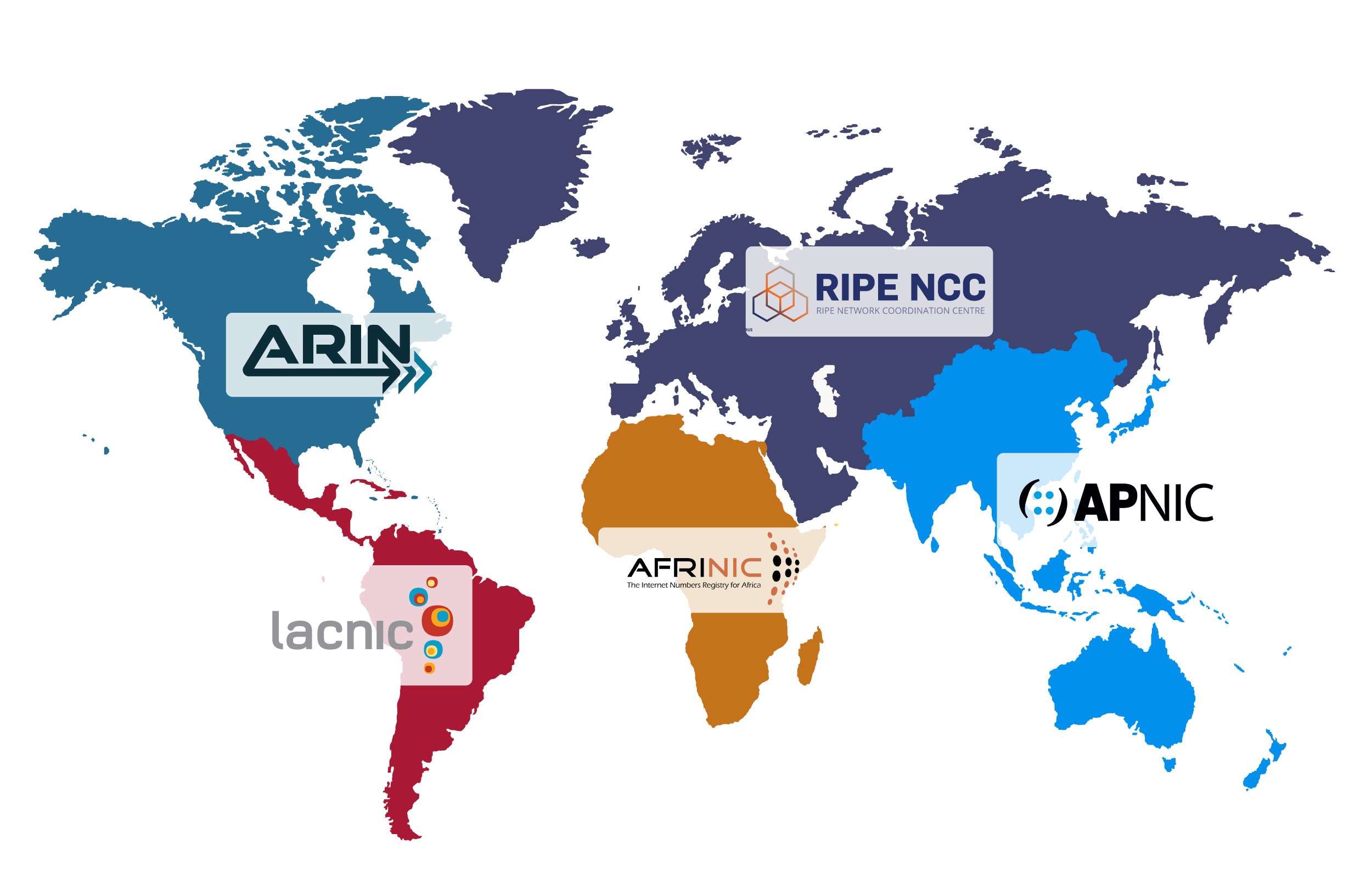
These resources are not managed by one company, one government, or one country. Instead, the global internet uses a distributed coordination model involving the Internet Assigned Numbers Authority, known as IANA, and five Regional Internet Registries, commonly called RIRs.The five RIRs are ARIN, RIPE NCC, APNIC, LACNIC, and AFRINIC. Each organization serves a specific geographic region and is responsible for registering and administering internet number resources within that region. Together, they form a core part of the internet’s global coordination structure.For businesses applying for an ASN, acquiring IPv4 resources, requesting IPv6 address space, operating BGP, or managing internet infrastructure, understanding the role of these five organizations is essential.
What Is a Regional Internet Registry?
A Regional Internet Registry is a non-profit or community-oriented organization responsible for coordinating internet number resources within a defined geographic service area. RIRs maintain public registration databases, develop regional policies through community processes, and provide services related to IP addresses, ASNs, routing security, reverse DNS, and network resource management.
RIRs do not “own” the internet, and they do not control website content, domain names, cloud services, or internet access in general. Their role is narrower but extremely important: they ensure that public internet number resources are registered uniquely and can be traced to the responsible network operator or organization.Each RIR receives large blocks of address space and ASN resources through the global IANA system. It then manages registration and distribution according to policies developed by its regional internet community. These policies may differ between regions, especially in areas such as IPv4 transfers, resource eligibility, membership models, and documentation requirements.
The five RIRs work independently, but they cooperate through the Number Resource Organization, or NRO. The NRO represents the collective interests of the five RIRs and supports coordination on global internet number policy matters.
The Five RIRs at a Glance
| Regional Internet Registry | Full Name | Main Service Region |
|---|---|---|
| ARIN | American Registry for Internet Numbers | United States, Canada, and parts of the Caribbean/North Atlantic |
| RIPE NCC | Réseaux IP Européens Network Coordination Centre | Europe, the Middle East, and parts of Central Asia |
| APNIC | Asia Pacific Network Information Centre | Asia-Pacific region |
| LACNIC | Latin American and Caribbean Internet Addresses Registry | Latin America and much of the Caribbean |
| AFRINIC | African Network Information Centre | Africa and the Indian Ocean region |
Although each RIR has a geographic service area, an organization’s network design, legal entity, operational presence, and resource-use situation can affect which RIR process applies. Businesses should not assume that the location of one office alone determines the correct registry. A sponsoring LIR, internet resource consultant, or the relevant registry can help confirm the appropriate route before an application begins.
ARIN: The Regional Internet Registry for North America
ARIN, the American Registry for Internet Numbers, serves the United States, Canada, and several Caribbean and North Atlantic territories. It was established in 1997 and is responsible for the registration of IP address resources and Autonomous System Numbers in its service region.Organizations in the ARIN region may interact with ARIN directly for internet number resources. ARIN maintains its own registration system and public database, commonly referred to as the ARIN Whois database. The database enables users to identify the organization responsible for an IP network or ASN, subject to the privacy and data-handling practices applicable to the relevant registration.

ARIN is especially important for North American ISPs, cloud providers, enterprises, universities, hosting companies, financial institutions, and data centers. As with every RIR, IPv4 availability is limited because global unused IPv4 space has been exhausted. Organizations needing IPv4 connectivity may use existing address holdings, provider-assigned IP space, leasing arrangements, or transfer mechanisms according to applicable ARIN policies.
ARIN also supports IPv6 deployment. IPv6 is widely regarded as the long-term solution to IPv4 address exhaustion, and ARIN encourages organizations to plan for IPv6 rather than relying exclusively on scarce IPv4 resources. A company with a North American operational presence may need to consider ARIN policies when requesting address space or ASNs directly within its service region.
RIPE NCC: The Regional Internet Registry for Europe, the Middle East, and Central Asia
RIPE NCC is the Regional Internet Registry serving Europe, the Middle East, and parts of Central Asia. It is one of the best-known RIRs because of the scale and diversity of the region it serves. RIPE NCC provides registration services for IP addresses and ASNs, maintains the RIPE Database, supports routing-security initiatives, and works closely with Local Internet Registries.
A Local Internet Registry, or LIR, is generally an organization that provides internet number resource services to itself or to end users. Many businesses obtain a RIPE NCC ASN, IPv6 resources, or related registry services through a sponsoring LIR rather than becoming a direct RIPE NCC member.This sponsoring-LIR model is useful for companies that need an ASN or internet number resources but do not require full direct membership. A professional sponsoring LIR can assist with document review, end-user registration, ASN applications, IPv6 requests, RIPE Database updates, RPKI configuration, route objects, and ongoing resource administration.

RIPE NCC is particularly relevant to hosting providers, European data centers, VPN operators, cloud businesses, telecom companies, global enterprises, and organizations building BGP infrastructure in Europe or the Middle East. Companies commonly use a RIPE NCC ASN for multi-homing, IP transit, Internet Exchange Point peering, cloud connectivity, DDoS mitigation, and independent routing control.
The RIPE Database is an important operational resource. It contains information about IP networks, ASNs, contacts, organizations, routing objects, and other technical records. Accurate information in the RIPE Database can help upstream providers, peers, security teams, and network operators validate routing and contact responsible parties during technical or abuse-related incidents.
APNIC: The Regional Internet Registry for Asia-Pacific
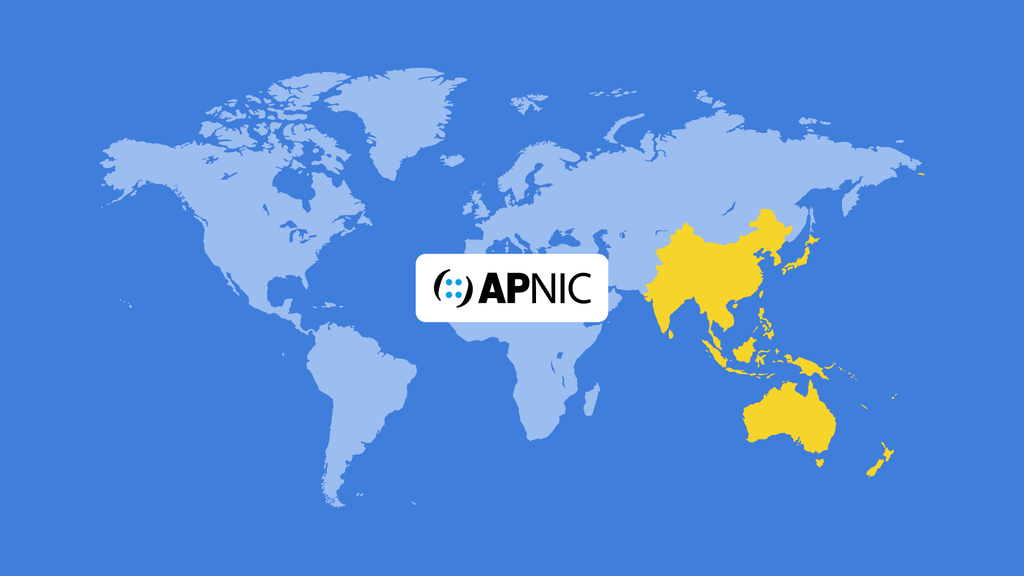
APNIC, the Asia Pacific Network Information Centre, serves the Asia-Pacific region. This includes a broad and diverse group of economies and countries across East Asia, Southeast Asia, South Asia, Oceania, and the Pacific Islands.
The Asia-Pacific region contains some of the world’s largest internet populations, fastest-growing digital markets, and most complex connectivity environments. APNIC plays a critical role in supporting ISPs, mobile carriers, data centers, cloud providers, academic networks, governments, and enterprises throughout this region.As in other regions, APNIC manages IP address and ASN registration through community-developed policies. IPv4 scarcity is a significant issue for many APNIC-region businesses, particularly as demand continues to grow for cloud infrastructure, broadband access, mobile services, online platforms, and connected devices.
IPv6 deployment is especially important in the APNIC region. Many large Asian mobile operators, internet providers, and digital platforms have adopted IPv6 at significant scale. Businesses operating in Asia-Pacific should consider IPv6 compatibility not only as a long-term infrastructure project, but also as a practical requirement for reaching users and connecting efficiently with regional networks.
Organizations that require an ASN in the APNIC region should have a clear BGP routing need. This may include connecting to multiple upstream providers, establishing direct peerings, operating multi-site infrastructure, announcing public address prefixes, or implementing an independent routing policy.
LACNIC: The Regional Internet Registry for Latin America and the Caribbean
LACNIC is the Regional Internet Registry serving Latin America and much of the Caribbean. Its full name is the Latin American and Caribbean Internet Addresses Registry.LACNIC supports a large region with different languages, legal systems, network environments, and levels of infrastructure maturity. Its members and users include ISPs, governments, universities, telecom companies, content providers, enterprises, data centers, and emerging digital businesses.

Like the other RIRs, LACNIC manages registration information for IPv4, IPv6, and Autonomous System Numbers. It also supports community discussions, technical training, regional internet development, and policy processes.Businesses operating in Latin America may need an ASN when they require redundant connectivity, direct peering, independent traffic management, or their own BGP routing policy. A company with operations across several countries may use an ASN to create a more consistent routing strategy across data centers, cloud connections, and internet transit providers.
IPv6 adoption is increasingly important in Latin America and the Caribbean as digital infrastructure expands. New networks and services should ideally be designed for dual-stack operation from the beginning. This allows continued IPv4 compatibility while ensuring that customers and partners with IPv6 connectivity can access services through the newer protocol.
AFRINIC: The Regional Internet Registry for Africa
AFRINIC, the African Network Information Centre, serves Africa and the Indian Ocean region. It is responsible for the coordination and registration of internet number resources for networks operating within its service area.

Africa has one of the world’s most dynamic internet-growth environments. Mobile connectivity, broadband expansion, cloud services, fintech, e-commerce, digital government services, and regional data centers continue to increase demand for reliable internet infrastructure. AFRINIC’s role is therefore significant for the development of local and regional networks.Organizations in the AFRINIC service region may require IPv6 address space and ASNs as they expand their networks, create new services, establish multiple upstream connections, or join regional Internet Exchange Points. Internet Exchange Points can be particularly important in Africa because local peering can improve performance, reduce international transit costs, and keep regional traffic closer to users.
As elsewhere, IPv4 scarcity remains a challenge. IPv6 offers a sustainable path for expansion, especially for new broadband networks, mobile services, cloud deployments, and IoT projects. Companies that plan their IPv6 architecture early can reduce future dependence on expensive or difficult-to-obtain IPv4 resources.
How the Five RIRs Work Together
The five RIRs serve separate regions, but the internet requires global coordination. An ASN registered through RIPE NCC, ARIN, APNIC, LACNIC, or AFRINIC can be used in global BGP routing. An IPv6 prefix registered through one RIR can be announced internationally, subject to the network operator’s routing configuration and the policies of transit providers and peers.
The RIR system works because each number resource is intended to be unique. No two independent networks should use the same public ASN in global routing, and no two organizations should announce the same public address range without authorization. The public registration databases maintained by RIRs help support that uniqueness and accountability.
The five RIRs also cooperate on technical and policy matters through the Number Resource Organization. At the global level, policy proposals can be developed through open, bottom-up processes involving the RIR communities. This multi-stakeholder approach is one of the defining characteristics of internet number resource governance.For network operators, this structure means that internet resources are not merely technical values in a router configuration. They are part of a globally coordinated registration system. Accurate resource records, responsible routing practices, valid contact information, and current security authorizations are all important.
RIRs, ASNs, and BGP Routing
An ASN is a core resource for organizations that need independent BGP routing. BGP is used by networks to exchange reachability information and determine how internet traffic travels between Autonomous Systems.
A business may need an ASN when it connects to two or more upstream providers, peers at an Internet Exchange Point, operates several data centers, announces its own IP prefixes, or requires independent traffic-engineering policies. An ASN allows the business to establish a distinct routing identity and apply policies that are not controlled solely by an upstream provider.The RIR responsible for the relevant region manages the registration process for the ASN. However, ASN assignment is only the administrative beginning. After receiving an ASN, the network operator must still configure BGP sessions, define route policies, create or maintain routing records where necessary, configure RPKI Route Origin Authorizations, and coordinate with upstream providers.
For example, a company obtaining an ASN through a RIPE NCC sponsoring LIR may subsequently establish BGP transit with two carriers, announce an IPv6 prefix, publish appropriate route objects, create RPKI ROAs, and monitor route propagation. The same general operating model applies regardless of which RIR manages the registration.
RPKI and Routing Security Across All RIR Regions
RPKI, or Resource Public Key Infrastructure, is an important routing-security framework supported across the global RIR system. It enables a resource holder to create a Route Origin Authorization, or ROA, that specifies which ASN is allowed to originate a particular IP prefix.
For example, an organization may create a ROA confirming that its IPv6 prefix can be announced by its ASN. Networks that perform RPKI route-origin validation can use this information to identify whether a route is valid, invalid, or not found.
RPKI does not solve every BGP security problem, but it is an important part of modern routing hygiene. Organizations that operate ASNs and public IP space should consider RPKI alongside prefix filtering, IRR route objects, monitoring, maximum-prefix limits, secure router configuration, and incident-response procedures.
Because routing is global, good security practices matter across all RIR regions. A routing misconfiguration in one country can affect reachability in another. Accurate RIR registration data and well-managed RPKI records help improve trust and stability throughout the internet ecosystem.
Choosing the Right Registry Path for Your Business
Businesses should not choose an RIR simply because it is familiar or because another company uses it. The appropriate registry path depends on the organization’s legal entity, network location, operational presence, service region, existing resource relationships, and current policy requirements.
A European cloud provider, for example, may work through a RIPE NCC sponsoring LIR. A North American ISP may follow ARIN procedures. A company operating network infrastructure in Singapore, Japan, Australia, India, or another Asia-Pacific location may need to consider APNIC. Similar regional considerations apply to LACNIC and AFRINIC service areas.For businesses with international operations, the decision can be more complex. The legal entity applying for the resource, the location of the network infrastructure, the organization operating BGP, and the intended use of the resources should be consistent and clearly documented.
Before applying for an ASN, IPv6 resources, or transferred IPv4 space, companies should confirm current policy requirements with an experienced sponsoring LIR, registry service provider, or the relevant RIR. Policies, documentation expectations, and available service options can change over time.
Five Organizations Supporting One Global Internet
ARIN, RIPE NCC, APNIC, LACNIC, and AFRINIC are the five Regional Internet Registries that support the global coordination of IP addresses and Autonomous System Numbers. Each organization serves a different geographic region, but all five contribute to a single interoperable internet.the RIR system provides the framework for obtaining and managing essential network resources. Whether a company needs an ASN for BGP routing, IPv6 resources for long-term growth, IPv4 transfer support, RPKI configuration, or accurate public registry records, the relevant Regional Internet Registry plays an important role.
As IPv4 scarcity continues and IPv6 deployment grows, businesses should treat internet number resources as strategic infrastructure. A well-planned ASN, IP address, and routing-security strategy can improve network resilience, support global expansion, and provide greater control over how services connect to the internet.